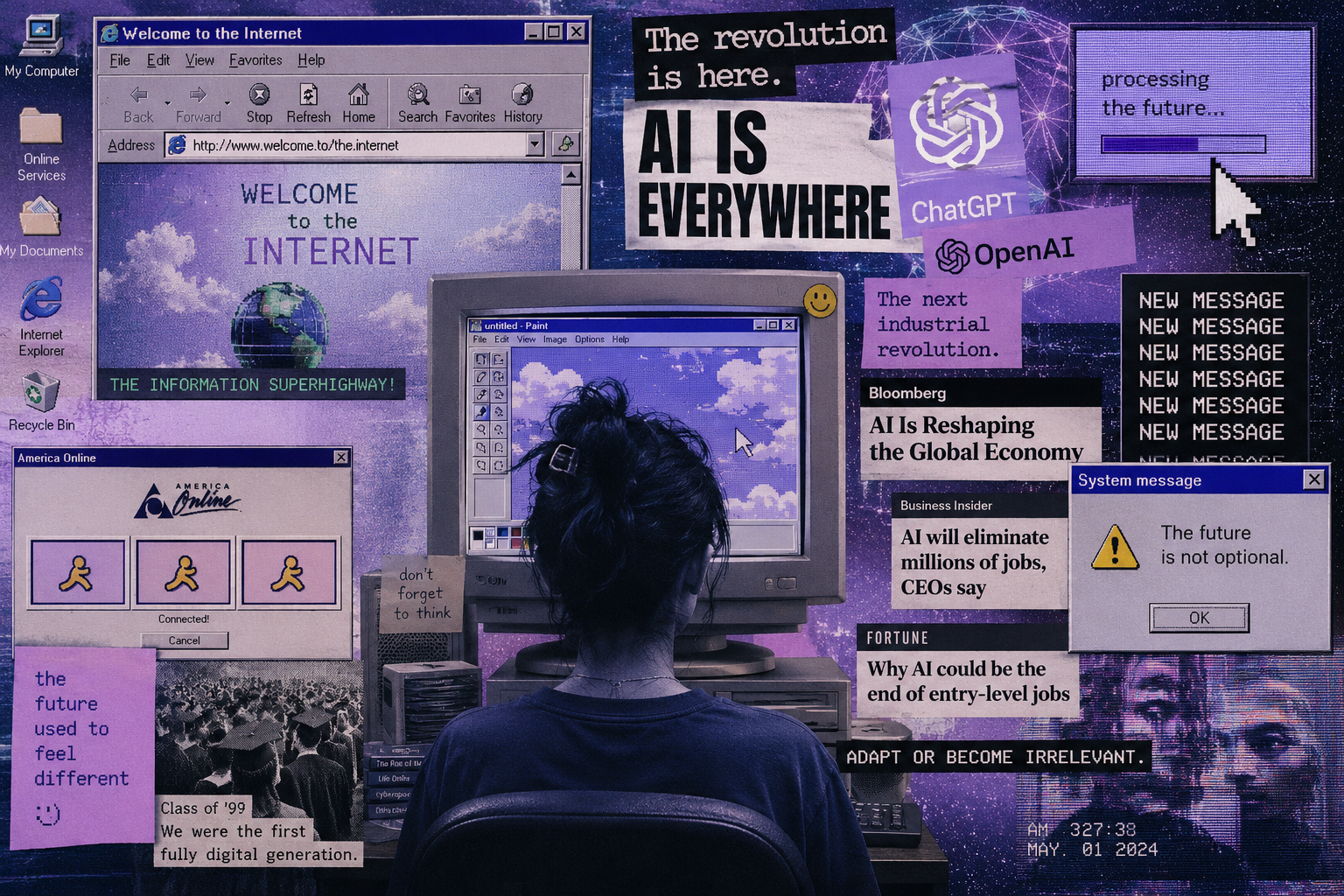
Does anyone else feel like we’re being gaslit into accepting the implementation of AI as inevitable societal progress, and if you question that at all, you’re suddenly “anti-progress”?
Lately, my Instagram reels have become an endless scroll of commencement speech after commencement speech of tone deaf AI evangelists and tech moguls claiming this to be “the next Industrial Revolution” (like Gloria Caulfield at the University of Central Florida commencement) and telling graduates to “deal with it… it’s a tool” (as Scott Borchetta did at Middle Tennessee State University commencement). I’m sure much of it has to do with my algorithm, but this AI push feels weirdly coordinated. Like we’re all supposed to embrace that this is unquestionably the future. Our future.
This is one of the biggest societal shifts and technological advances in modern history, and certainly in my lifetime, and we’re not allowed to question who benefits from it all?!
Let me first set the record straight before anyone claims I’m an AI conspiracy theorist. I’m not. I’m just tired of being told that my concerns aren’t valid. Do I think AI is useful? Absolutely. Do I think it is powerful and will do many great things? Absolutely. I’ve been working in digital media for over a decade now and earned my master’s degree in digital media just last year. AI can be immensely cool and, truthfully, helpful. I’ve seen firsthand some of the benefits of integrating AI into my workflows. And there are areas where AI is being used as a force of good in ways that meaningfully help people. From healthcare diagnostics and medical imaging to accessibility tools like real-time captions and transcriptions.
However, I do think there are very real concerns about who is building these systems, who benefits from them, and the lack of transparency and accountability surrounding all of this. In talking to colleagues, friends, and peers, I’m not the only one who feels pressured to unquestioningly accept this “AI or bust” message in order not to risk my job or career advancement.
According to a poll published by Quinnipiac in March 2026, only 5% of Americans feel AI development is being led by people or organizations that represent their interests.
Everywhere we look, the messaging is the same: AI is inevitable. Get on board or get left behind. Or AI won’t take your job, but someone who knows how to use AI will.
It feels like a coordinated push from tech kings, billionaires, and corporations. Every product suddenly is “AI-powered,” even when it doesn’t need to be. Almost every boardroom is talking about how to invest in and integrate AI. But these systems are built by a handful of extremely wealthy companies, for profit, with almost no accountability.
AI, Layoffs, and the Convenient Corporate Narrative
We are also watching firsthand a reshaping of the job market and a devaluing of human labor and intelligence as company after company announces layoffs. You can’t scroll through LinkedIn without seeing a flood of posts by professionals who recently lost their jobs. They’re “open for work”, hoping to compete with the thousands of others applying for a limited number of open roles, trying to lean into their “networks.”
Corporations are framing these layoffs as “AI efficiencies” and pushing for automation. Companies are telling employees that “AI is the future,” while simultaneously reducing headcount. It’s become both a justification and a future-facing explanation. While AI is certainly a part of this new era of mass layoffs, it’s ultimately a convenient narrative to appease shareholders and disguise capitalist greed as innovation.
“In many cases, analysts say the layoffs are less about AI replacing workers today and more about reallocating capital toward AI infrastructure tomorrow.”
If you are laying people off without a mature, ready-to-go AI agent to do the work, you are not laying off people because of AI,” Gownder said. “You are laying people off for financial reasons and then imagining that at some future date, AI may be able to do the work.”
THIS. THIS is what so much of this feels like.
So my skepticism (I’m not even sure if that’s the right term) is not necessarily about the technology itself, but instead the power behind it.
We’re being told to buck up and trust this technology will improve society while simultaneously watching corporations use it to justify workforce reductions. We’re being told this is progress while losing our jobs, stability, healthcare, and financial security. We’re watching some of the most powerful and wealthy corporations and individuals in the world aggressively push a technology that they will profit from enormously while expecting the rest of society to trust them without question. But who actually benefits from this?
These are the same institutions that have normalized mass surveillance, addictive algorithms, data harvesting, and the ”move fast and break things” mentality. And now we’re supposed to trust and believe those same institutions will responsibly guide one of the most significant technological shifts in modern history???
Profit over people.
Profit over privacy.
Profit over humanity.
Profit over everything.
Why This Revolution Feels Different
I know there’s that argument that this is how people felt in the 80s and 90s when computers and then the internet were introduced and became an integral part of the workplace. And maybe all technological revolutions feel this way, and change is hard and scary, and this just happens to be the first one I’m facing in my adulthood and during my career. Maybe that’s why it feels so jarring.
The Computer Revolution and the Dot-Com Era/Internet Age were significant societal shifts in how we work with, store, and share information. However, one of the biggest differences (and please, if you disagree, I want to hear your perspective) is that previous digital revolutions felt like they were building alongside humans, while this one increasingly feels like it’s being built to replace them. Computers and the internet were largely designed and marketed as tools to empower and connect people. While AI is targeted as a way to optimize, automate, and reduce the need for human labor. It feels like we’re becoming economically disposable.
“In the 1990s, tech moguls, interested in individual consumers rather than corporate buyers, used utopian language to describe the internet as a marker of human progress that could improve productivity, provide easier access to consumer goods, and increase leisure time. Why? They wanted to sway the public to purchase the internet for home use.
Today, tech companies often downplay the criticisms of workers who are now being pressed to use technology that could transform, reduce, or eliminate their own jobs.”
How could that not fundamentally change the way we experience this digital revolution?
And maybe part of what feels so unsettling about all of this is the speed.
We barely had time to process what generative AI even was before it became embedded everywhere. Into workplaces, classrooms, search engines, social media platforms, creative industries, hiring processes, customer service systems, and expectations around productivity. AI went from an exciting new technology to something people are now being professionally and socially pressured to adopt, whether they feel comfortable with it or not.
And again, I don’t think people are irrational for questioning that.
Especially because we’ve seen what happens when massive tech platforms are rolled out quickly without fully understanding the societal consequences. Social media was once framed as something that would connect the world, democratize information, and bring people together. And while it absolutely did some of those things, it also contributed to misinformation, surveillance capitalism, addictive algorithms, declining privacy, and enormous mental health consequences that we are still trying to untangle in real time.
We’re also living in a time and economic place of great financial inequality. The wealth gap continues to increase. Families are losing their health insurance. Education is putting young people into severe debt before they’ve started their first job. Housing prices are unattainable for many (at least here in the northeast). Wages are stagnant. PEOPLE ARE TIRED. People are exhausted by how little control they feel they have over their own lives. And on top of all of that, people are pressured (or even threatened?) to enthusiastically adopt a technology that is fundamentally changing, and could even eliminate, the jobs they depend on.
And I think that’s why so many people are questioning AI right now.
We’re Not Anti-AI. We’re Paying Attention.
We’re looking at who is building these systems, who is funding them, who profits from them, who is being displaced by them, and how little say the rest of us seem to have in shaping any of it. And why is skepticism is so quickly dismissed as fear or ignorance.
People are paying attention.
Anyway, I started this blog because I feel like there are a lot of us out there. Not anti-AI, but pro-having a voice. Pro-thinking critically. Pro-feeling like in our gut, something isn’t right about all of this. Pro-it’s ok to speak up when the giants tell you to shut up or get left behind.
Because “adapt or become irrelevant” is a threat, not a vision.
Tired of all the thought leadership crap out there? 🤮
Subscribe for real human thoughts about increasingly non-human technology. Plus the AI, media, and internet stories that I think are actually worth your time.
Thank you for subscribing!
Please check your email to confirming your subscription.